How a leased plot affects an apartment's price
On a leased plot an apartment's price is lower but the monthly cost is higher. How plot rent is converted back into capital, why it matters who owns the plot, and how the rent can multiply in one go when the lease is renewed.
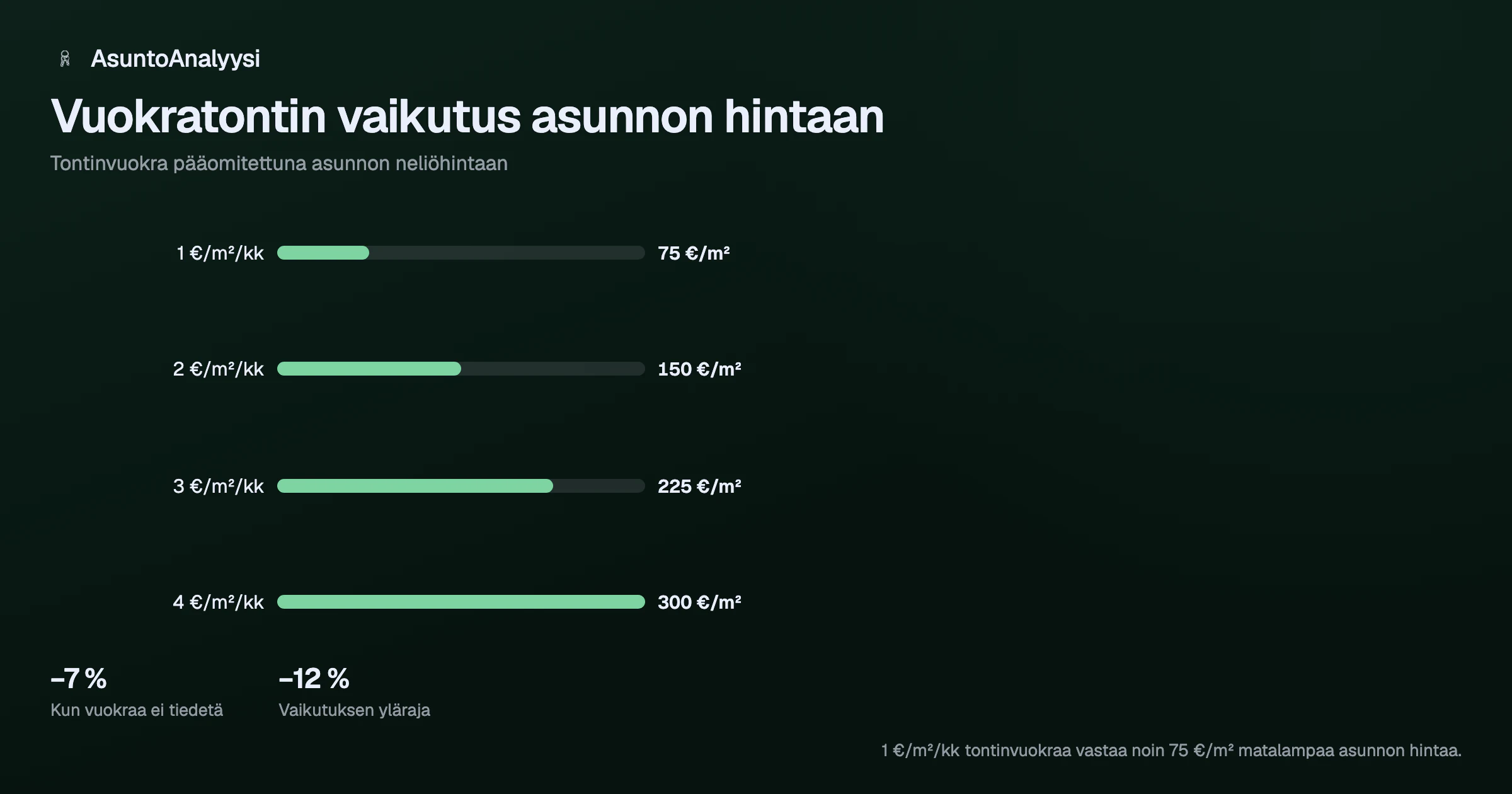
The effect comes from a cost that has been moved
A housing company on a leased plot does not own the land the building stands on; it pays rent for it. For the shareholder the rent appears in the charges, either as a separate item or included in the maintenance charge (hoitovastike). The debt-free price of the apartment is therefore lower than on a comparable owned plot, but the monthly cost is higher. Neither is a free lunch: the buyer pays for the same land either as a lump sum in the sale price or in instalments for as long as they own the home.
This is exactly what makes comparing homes on leased plots treacherous. Search results show only the price, and on that basis a home on a leased plot looks cheap. A comparable figure only emerges once the plot rent is converted back into capital.
How big the effect is in euros
AsuntoAnalyysi's model treats plot rent on the same principle as the maintenance charge: an ongoing cost is capitalised at a required return of about 8%, so €1/m² a month corresponds to about €75/m² in the apartment's price. The effect is capped at 12% of the area's price per m², so that one exceptional rent does not take the estimate entirely away from the market level.
Below is the effect for a 60 m² apartment in an area where the price per m² is €4,000/m² (an illustrative example, not an average calculated from the data):
| Plot rent | €/month | Effect €/m² |
|---|---|---|
| €0.50/m²/mo | €30 | −€38/m² |
| €1.00/m²/mo | €60 | −€75/m² |
| €1.50/m²/mo | €90 | −€113/m² |
| €2.00/m²/mo | €120 | −€150/m² |
| €3.00/m²/mo | €180 | −€225/m² |
| €4.00/m²/mo | €240 | −€300/m² |
| €7.00/m²/mo | €420 | −€480/m² * |
When the rent is not stated
Quite often the listing does not show how much the plot rent is, because it may be merged into the maintenance charge without being itemised. In that case the model uses a fixed deduction of −7%, which matches the typical price gap between homes on leased plots and homes on owned plots.
In our example apartment that is €280/m², or €16,800. One thing follows from this: if the actual plot rent is moderate, the missing information costs the seller money. According to the table, a rent of €1.00/m² a month would mean only €75/m², while an unknown amount takes €280/m². It always pays to state the rent when it is below €3.73/m² a month.
Who owns the plot
The landlord is usually the city or municipality, but not always. Plots are also owned by private landowners, parishes, foundations and, increasingly in recent years, property investors and funds. The difference does not show in today's monthly charge, but it matters to the buyer, because it tells you what is likely to happen when the lease ends.
As a tenant of the city, a housing company is in a more predictable position: the principles for setting the rent are public, decisions are made by a political body, and the city typically has a land-policy interest in keeping housing affordable. A private owner is guided by a return target, and the lease is renewed on market terms. The plot can also change owner during the lease. The terms of the current lease then stay in force, but whoever applies them at the next review is a different party from the one when the building was built.
Why the rent can rise quickly
Plot rent changes through two different mechanisms, and their scale is completely different:
- Ongoing index adjustment during the lease. The rent is typically tied to the cost-of-living index, so it follows the general price level. This is predictable and moderate.
- Renewal of the lease, where the rent is set again based on the plot's current value. This is not an adjustment of the old rent; the price is set from scratch.
The second one is what catches people out. Plot leases are long, often several decades, and over that time land values in growth centres have risen much more than the general price level. When the lease is renewed, the whole difference is settled in one go: the rent can multiply even though nothing in the apartment or the building has changed. Plot rent is only one part of the charges, so the charges do not rise in the same proportion. They do rise, though, and a higher ongoing cost lowers the apartment's value by exactly the same logic as the table in this article.
Why the effect varies with the market
Some pricing factors are stable across the cycle: the size of the apartment, the floor, the lift and the sauna have roughly the same effect whether it is a buyer's or a seller's market. A leased plot is not one of them. It is a cyclical factor that deepens in a buyer's market: when buyers are few, an ongoing extra cost is penalised more harshly, and when demand is strong, it is overlooked.
For this reason the gap observed in realised sales varies roughly between −5% and −9.5%. The model uses the middle value of −7% rather than either extreme. In practice, for the buyer: the relative discount on a home on a leased plot is largest exactly when the market is quiet anyway, and it narrows if the market turns before you sell.
In brief
- A leased plot moves the price of the land from the sale price into the monthly cost, and a comparable figure only emerges once the rent is capitalised back.
- €1/m² a month of plot rent ≈ €75/m² in the apartment's price, capped at 12% of the local level.
- If the amount is not stated, the deduction is −7%, often more than the actual rent would warrant.
- Check the landlord and the end year of the lease: on renewal the rent is set from the plot's current value and can multiply in one go.
- The effect is cyclical: it deepens in a buyer's market and narrows in a seller's market.
You can see the figure for your own property by pasting an Oikotie or Etuovi link into the search box on the front page: the analysis shows the effect of the plot rent on its own line and includes it in the monthly cost. The reasoning behind the coefficients is on the method page (in Finnish).